
Trastevere and the Jewish Ghetto: 7-Stop Walking Itinerary
Some places in Rome deserve more than a single photograph. The Jewish Quarter and Trastevere reveal themselves when you walk slowly, look at the façades, cross the Tiber and take time to explore the stories they hold.
This cultural itinerary between the Jewish Ghetto and Trastevere links remains from antiquity, places of memory, Jewish-Roman traditions and basilicas rich in art. It is a route suited to small groups of friends, cultural associations and travellers who want to explore the city in depth without packing too many visits into a single day.
The walk starts in Piazza Mattei, crosses the Tiber Island and ends in Piazza di Santa Maria in Trastevere: seven stops to enjoy in half a day, with the option of adding a visit to the Jewish Museum of Rome.
Trastevere and Jewish Ghetto itinerary: route and duration
Piazza Mattei → Portico d'Ottavia → Great Synagogue and Jewish Museum → Tiber Island → Santa Cecilia in Trastevere → Piazza in Piscinula and alleys → Santa Maria in Trastevere.
Starting in the Jewish Quarter lets you devote the first part of the visit to history and memory, then cross the river and finish among the squares of Trastevere.
- Starting point: Piazza Mattei, by the Fontana delle Tartarughe;
- Finishing point: Piazza di Santa Maria in Trastevere;
- Approximate distance: about 2.5–3 km, depending on detours;
- Walking time: about 45–60 minutes without stops;
- Recommended duration: 3–4 hours, with cultural stops and a short break;
- Jewish Museum visit: to be booked and added to the programme;
- Ground: cobblestones, uneven paving, road crossings;
- Recommended format: small group, with a licensed guide to explore history and heritage in depth.
Times and distances are organisational estimates. They do not include transfers from the hotel, lunch, waiting times or in-depth visits to interiors.
Organising a group trip to Rome? Email info@hoteldomidea.com with your dates, number of participants and rooms required to receive a stay proposal from Hotel Domidea.
1. Piazza Mattei and the Fontana delle Tartarughe
The walk begins in a quiet square, ideal for introducing the route before reaching the busier streets.
The Fontana delle Tartarughe invites you to notice the details: the figures, the movement of the composition and its relationship with the surrounding palazzi. It is a pleasant first stop even for those visiting Rome for the first time, because it shows how much there is to discover away from the most famous monuments.
From Piazza Mattei, continue along Via della Reginella towards Via del Portico d'Ottavia.
For the group: choose a precise meeting point, keeping residents' doorways and passageways clear.
Suggested stop: 15 minutes.
2. Portico d'Ottavia and the Jewish Quarter: reading history in the places
The Portico d'Ottavia introduces the archaeological dimension of the walk. The ancient complex, rebuilt by Augustus and dedicated to his sister Octavia, sits in a neighbourhood shaped by profound transformations.
Here it is important to distinguish two stories: the Jewish presence in Rome predates the establishment of the ghetto by many centuries. The ghetto was imposed in 1555 by Pope Paul IV. Today's quarter preserves traces of that segregation, but it is also a place of contemporary life, culture and identity.
Set aside a moment for Largo 16 Ottobre 1943, whose name commemorates the Nazi roundup of Rome's Jews. A cultural visit gains value when it also leaves room for understanding and reflection.
What to look for: the remains of the portico, the transformations of the buildings, the inscriptions and the memorials along the route.
Suggested stop: 30–40 minutes.
3. Great Synagogue and Jewish Museum of Rome
Continuing towards the Lungotevere, you reach the Tempio Maggiore, the Great Synagogue of Rome, a landmark of the city's Jewish community.
The exterior stop allows you to observe the building and its presence in the urban landscape. To understand the community's history, traditions and heritage more deeply, consider a visit to the Jewish Museum of Rome.
How to organise the visit to the Jewish Museum and the Synagogue
Access should not be treated as a spontaneous extension of the walk. For a group, choose and book the visit format you want on the official website of the Jewish Museum of Rome, checking which spaces are included and the access instructions.
The museum is closed on Saturdays and during Jewish holidays. Always check the calendar before fixing your programme.
If you include the museum, allow the time required by the chosen visit and consider extending the itinerary beyond half a day. A guided tour of the quarter does not automatically include admission to the Synagogue.
Suggested exterior stop: 15–20 minutes.
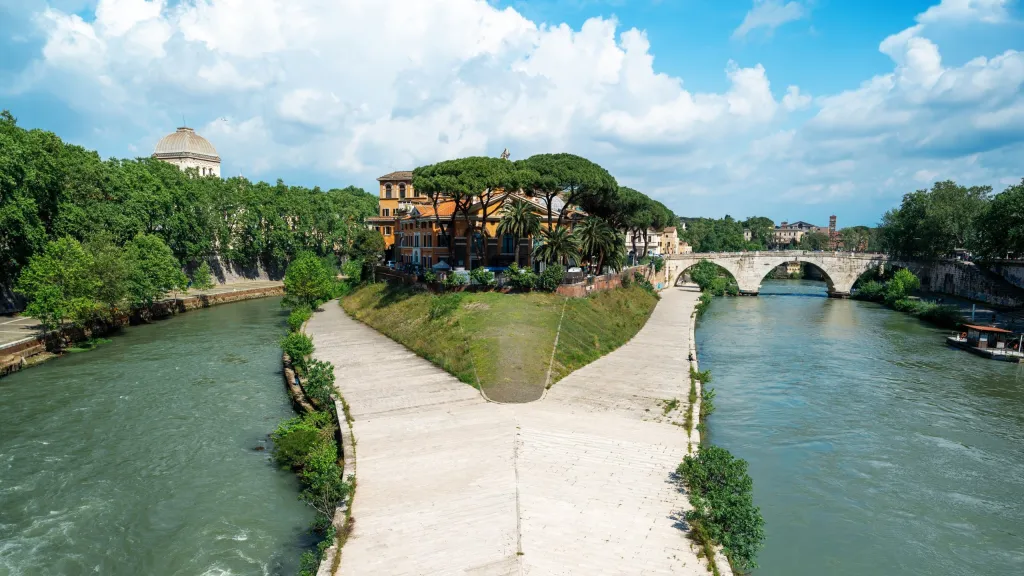
4. Tiber Island: the crossing between the two banks
Reach Ponte Fabricio and cross it onto the Tiber Island. The scene changes: the narrow streets of the quarter give way to views of the river and the perspective of the bridges.
It is the natural link between the two parts of the itinerary and a good moment to pause the story. Look at the Tiber, orient yourself with respect to the banks, then continue over Ponte Cestio towards Trastevere.
For the group: stop in a space that does not block the passage. It is not necessary to go down to the embankments to follow the route.
Suggested stop: 15–20 minutes.
5. Santa Cecilia in Trastevere: a stop dedicated to art
Once you reach the Trastevere bank, head towards Santa Cecilia in Trastevere. This stop introduces a quieter part of the district than the busier squares.
The basilica houses an important medieval apse mosaic. The complex is also linked to Pietro Cavallini's famous Last Judgement: if you want to include it, check the specific access conditions, without assuming they are the same as those of the basilica.
For a group visit, agree on how to behave in places of worship and respect any services taking place.
Suggested stop: 20–30 minutes for a short visit, subject to opening times. Additional spaces require separate time and checks.
6. Piazza in Piscinula and the alleys of Trastevere
From Santa Cecilia, return towards Piazza in Piscinula, then continue towards Via della Lungaretta and Piazza di Santa Maria in Trastevere.
This stretch invites you to look beyond the signs of the restaurants: doorways, façades, small squares and glimpses tell the story of an urban fabric to be explored at leisure.
Visiting Trastevere in a small group makes it easier to move around and to hear the guide without blocking the alleys entirely. Keep the group together, and leave space for residents, shops and passers-by.
Suggested time: 20–30 minutes of walking and short stops.
7. Santa Maria in Trastevere: the finale between square and mosaics
The route ends in Piazza di Santa Maria in Trastevere, one of the most representative spots in the district.
The basilica deserves a visit for its mosaics and for the relationship between its façade and the square. If access is permitted, go in calmly, keep your voice low and follow the posted instructions.
After the visit you can end the walk with a break, or continue to a lunch or dinner booked in advance.
Suggested stop: 25–35 minutes, depending on opening times and the group's interest.
Where to eat: Jewish-Roman cuisine and Trastevere tradition
Food can enrich the route, provided it is given the time it needs.
In the Jewish Quarter you can look for dishes from the Jewish-Roman tradition, such as carciofi alla giudia (fried artichokes in the Jewish style), checking availability and seasonality. In Trastevere you can finish with a meal dedicated to Roman cuisine.
For a small group, book in advance and tell the restaurant about dietary needs and allergies. A restaurant in the Jewish Quarter is not automatically kosher: if this requirement matters to you, check the certification and features of the service directly.
To keep the visit relaxed, add lunch to your timings rather than treating it as included in the 3–4 hours.
Tips for organising the route as a small group
Choose the day according to the interior visits
If you want to include the Jewish Museum, check the opening calendar first. For the basilicas, consider religious services and any separate access to the art spaces.
Adapt the pace to the participants
The route is relatively short, but cobblestones and standing stops can be demanding. Plan a break with seating and check any accessibility needs in advance.
Prefer a guide for deeper understanding
A licensed guide can connect archaeology, Jewish history and medieval art, helping the group understand the differences between the places. For the museum, refer to the official visit formats.
Arrange transfers before the walk
Agree on a drop-off point that suits the means of transport used. For coaches or minibuses, the operator must check the permitted access, drop-off and pick-up points.
Only two hours?
Choose a short version: Portico d'Ottavia → exterior of the Great Synagogue → Tiber Island → Santa Maria in Trastevere. Skip the museum and the detour to Santa Cecilia, while still leaving margin for stops.
Where to stay for visiting Trastevere and the Jewish Ghetto
Accommodation is part of planning the trip: rooms, arrivals and transfers should be suited to the group's needs.
Hotel Domidea is a 4-star hotel in eastern Rome, outside the area of this walk. You will therefore need to plan a transfer to reach the starting point.
The hotel offers shuttle connections to the metro by reservation and subject to availability. Before including them in a group programme, check stops, timings, capacity and applicable conditions directly with the hotel.
Already have dates in mind? Time to organise your stay
Request a group proposal now: give your dates, number of people, and the quantity and type of rooms; contact Hotel Domidea to find a solution suited to your trip.
Want to book your stay straight away? Check availability and rates: book Hotel Domidea now.
For group requests, write to the hotel to check together the room availability you need.
FAQ – Trastevere and the Jewish Ghetto
Can you visit Trastevere and the Jewish Ghetto on the same day?
Yes. The two areas are linked on foot via the Tiber Island. A cultural walk takes roughly 3–4 hours; the museum, lunch and in-depth visits need additional time.
What is the walking route from the Jewish Ghetto to Trastevere?
From the Jewish Quarter, reach Ponte Fabricio, cross the Tiber Island and continue over Ponte Cestio. From there you can head to Santa Cecilia or to Piazza di Santa Maria in Trastevere.
How long is the full itinerary?
The route measures about 2.5–3 km, depending on the streets chosen and any detours. The actual walking time is roughly 45–60 minutes, without stops.
What is there to see in the Jewish Ghetto of Rome?
The main stops include the Portico d'Ottavia, the places of memory, the Great Synagogue and the Jewish Museum. Piazza Mattei and the Fontana delle Tartarughe complete the walk in the immediate surroundings.
Is the Jewish Museum of Rome open on Saturdays?
No. The museum is closed on Saturdays and during Jewish holidays. Check the official calendar before organising your visit.
Does the quarter visit include admission to the Synagogue?
Not automatically. The walk through the quarter, the museum visit and access to the synagogues depend on the format you choose. Check what is included when booking.
What is there to see in Trastevere besides restaurants?
Santa Cecilia, Piazza in Piscinula and Santa Maria in Trastevere allow you to build a visit focused on art, architecture and history, alongside the district's food scene.
Is the route suitable for people with reduced mobility?
A prior check is needed. Uneven paving, changes in level and access to individual buildings may require route adjustments and longer timings.
Is Hotel Domidea in Trastevere?
No. Hotel Domidea is in eastern Rome. The transfer to the centre should be planned separately from the walk.
How do I request a stay for a small group at Hotel Domidea?
Write to info@hoteldomidea.com, stating your dates, number of participants, rooms required and any organisational needs.