Meeting Rooms in Rome with Parking: The Complete Guide to Organising a Successful Corporate Event
A beautiful meeting room does not guarantee a successful event. If delegates arrive late, cannot park, struggle with the screen or spend the coffee break solving Wi-Fi problems, the address and décor become irrelevant. In Rome, where traffic, ZTL restrictions and cross-city journeys affect punctuality, location and logistics matter as much as the room itself.
This guide answers the queries behind “meeting room in Rome with parking”, “small conference venue Rome”, “hotel meeting room near GRA” and “corporate event venue Rome East”. It takes organisers from the first brief to final invoice, with practical checklists for board meetings, training days, interviews, workshops, hybrid events and residential conferences.
Has your event date been approved? The right room layout, guest rooms and parking capacity can disappear before the date itself is fully booked: check Hotel Domidea’s live room availability and secure accommodation directly now. For the meeting room and a tailored event quotation, email info@hoteldomidea.com with date, timetable, layout and participant count.
The 60-second venue checklist
| Requirement | What to confirm in writing |
|---|---|
| Capacity | Maximum for your chosen layout, not the room’s highest possible number. |
| Parking | Number of spaces, reservation, price, security description and vehicle limits. |
| Location | Peak-time routes from the participants’ real arrival points. |
| Wi-Fi | Dedicated connection, expected devices and backup. |
| AV | Display/projector, resolution, audio, microphones, adapters and technician. |
| Hybrid meeting | Platform, camera framing, echo control, remote test and recording consent. |
| Catering | Timings, quantities, dietary needs, service location and final numbers deadline. |
| Guest rooms | Allocation, rates, breakfast, cancellation and rooming-list deadline. |
| Accessibility | Step-free route from parking to room, toilet, lift and evacuation procedure. |
| Contract | VAT, city tax, overtime, attrition, cancellation and payment schedule. |
Why parking changes a corporate event
Parking is not merely an amenity when participants carry samples, laptops, banners or training materials. It influences punctuality, organiser workload and the first impression of the day. A central address can lose its prestige when twenty delegates call at 8:55 asking where to leave their cars.
“Parking available” remains incomplete. Ask whether it is:
- on-site or nearby;
- free, included or charged separately;
- reservable or first-come-first-served;
- covered or outdoors;
- guarded, gated, monitored or unguarded;
- compatible with vans, minibuses and adapted vehicles;
- available to day delegates as well as overnight guests.
Never promise participants a parking place until the venue confirms the allocation. Rome’s coach and commercial-vehicle access rules may require separate permits; ordinary car parking does not authorise a coach.
Central Rome or outside the restricted centre?
A central venue works when
Most guests arrive by train, the meeting is followed by client hospitality in the centre, and walking or metro access matters more than parking. The organiser must still clarify ZTL access, unloading and third-party garage arrangements.
An outside-centre venue works when
Guests arrive from different regions by car, the company is near the GRA, equipment must be delivered, or the event includes overnight rooms. A property near the correct motorway sector may reduce late arrivals and parking costs.
Rome East works when
Attendees use the A24, GRA, Via Tiburtina, Prenestina or Collatina, or work in eastern Rome. It is less efficient when nearly everyone comes from Fiumicino or has appointments in western Rome. Map attendee origins before selecting a postcode.
Start with the event brief—not a venue search
Write a one-page brief containing:
1. objective and measurable outcome;
2. event date plus one alternative;
3. start, finish and organiser access time;
4. expected, minimum and maximum attendance;
5. in-person and remote participant numbers;
6. room layout and breakout requirements;
7. AV, streaming and recording needs;
8. catering schedule and dietary requirements;
9. parking and vehicle profile;
10. bedrooms, billing and cancellation needs.
This brief produces comparable quotations. Without it, one venue may price an empty room while another includes screen, breaks and staff, making the lower figure meaningless.
Choosing the right room layout
Boardroom
One central table supports discussion, negotiation and executive meetings. It requires more space per participant and is poor for large presentations.
Theatre
Rows of chairs maximise attendance for presentations and briefings. It offers limited writing space and makes workshops harder.
Classroom
Tables face the speaker, suitable for training, laptops and note-taking. Capacity is lower than theatre style.
U-shape
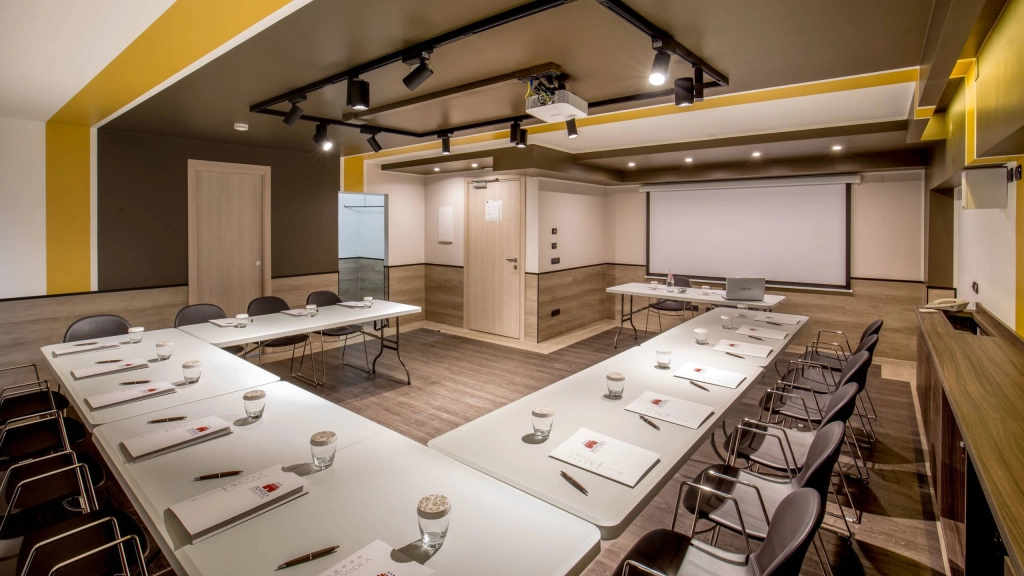
Useful for facilitation, demonstrations and discussion with a clear presentation focal point. It needs generous floor area.
Cabaret or islands
Small groups around tables suit workshops and collaboration. Confirm sightlines and circulation.
Never use the theatre maximum in an invitation for a classroom event. Ask for a scaled layout showing screen, doors, catering, columns and accessible routes.
Capacity at Hotel Domidea: what to confirm
Hotel Domidea describes its Aurea meeting facilities as 42 square metres with natural light and audio/video technology. Official hotel pages currently present different capacity descriptions:
- the English Meeting Center page states up to 14 seated boardroom-style and 20 theatre-style;
- another official page promotes small meetings for up to 25 people;
- a suite/business page uses broader wording extending beyond 25.
These statements may refer to different combinations of spaces or configurations. A responsible organiser should not select the largest published number. Send the exact layout, furniture, AV and catering requirements and obtain the approved capacity in the written quotation.
The Meeting Center page also refers to three rooms convertible into breakout spaces, natural light and terraces for seasonal light lunches in two rooms. Confirm which spaces are included in your specific proposal.
AV and hybrid-event checklist
Hotel Domidea’s Italian conference page lists dedicated enhanced Wi-Fi, amplification, audio/video recording and video projection with laser pointer. “Equipped” still requires a technical specification.
Ask for:
- projector or screen model, brightness, resolution and aspect ratio;
- HDMI, USB-C and required adapters;
- speaker system and microphone count/type;
- camera, field of view and remote-participant display;
- platform licence and host permissions;
- dedicated internet bandwidth and guest-network procedure;
- recording format, storage and delivery;
- technician presence and call-out cost;
- extension leads, clicker and backup laptop;
- rehearsal time.
Run a test using the presenter’s actual laptop and corporate security settings. A working venue computer does not prove that a locked-down company device will connect.
Privacy, recording and data protection
Hybrid events and interviews may process personal data. Tell participants if the session is recorded, define purpose and retention, collect appropriate consent where required and restrict access to files. Avoid displaying a public attendee list with personal contacts.
For confidential meetings, ask about sound transfer, room access, signage, document disposal and whether other events share breakout or terrace areas. Use unique Wi-Fi credentials where possible and never leave printed materials overnight without agreement.
Catering that supports the agenda
A coffee break should restore attention, not create a queue that delays the next session. Match service to the group size and programme.
Hotel Domidea states that coffee breaks, coffee stations and business lunches can be arranged, including through its lounge bar. Confirm:
- welcome coffee, mid-morning, lunch and afternoon timing;
- service inside, outside or in a separate area;
- final guaranteed participant number deadline;
- vegetarian, vegan, allergy, religious and medical requirements;
- labelled allergens and cross-contamination procedures;
- bottled water or refill points in the room;
- price per person, minimum spend, VAT and staff;
- wet-weather alternative for terrace service.
A 20-minute break for 25 people needs a different setup from a continuous coffee station for ten executives.
Bedrooms and residential meetings
Holding accommodation and meeting space in one hotel reduces transfers and late starts. Request a room block with:
- single versus double occupancy;
- breakfast inclusion and hours;
- individual payment or master account;
- rooming-list deadline;
- release date for unused rooms;
- cancellation and no-show terms;
- early arrival, late departure and luggage storage;
- city tax treatment and exemptions.
Do not mix a flexible delegate room block with a non-refundable public booking unless the cost risk is understood.
Hotel Domidea parking and arrival logistics
The hotel’s official facilities page lists private external unguarded parking subject to availability and a covered unguarded garage at €5 per car per day, reservable subject to availability. The external option is not explicitly described as free in the wording reviewed.
For a corporate event, confirm separately:
- spaces allocated to day delegates and hotel guests;
- garage versus external-area allocation;
- arrival order and overflow plan;
- van dimensions and unloading time;
- accessible spaces and step-free route;
- whether participants pay individually or parking is on the master account.
Hotel Domidea is in Tor Cervara, near GRA exit 14 and the A24 urban branch. Provide participants with the hotel’s official directions, not merely the postcode. Tell them not to drive through central Rome.
Public transport, shuttle and taxis
The official facilities page lists a Courtesy Bus to/from Repubblica (Metro A) and Rebibbia (Metro B), at set times, on request and subject to availability. This is not an on-demand vehicle and should not be assumed to carry an entire event group.
For delegates arriving by train, confirm whether the scheduled service fits their arrival. Otherwise provide the current public-transport route or arrange a dedicated group transfer. Ask reception to coordinate taxis at staggered departure times rather than ordering them all after the event closes.
Building the event budget
Compare quotations using a single spreadsheet or checklist with these lines:
room hire + setup + AV + technician + Wi-Fi upgrade + catering + staff + overtime + bedrooms + city tax + parking + transfers + signage + cancellation exposure + VAT.
Hidden differences commonly include:
- half-day versus full-day hours;
- organiser setup and breakdown time;
- weekend or evening supplements;
- minimum catering spend;
- technician required for streaming;
- room reset between sessions;
- recording delivery;
- parking not included for day guests;
- attrition on unused bedrooms.
Ask for a total including VAT where applicable and identify every optional line before internal approval.
A realistic planning timeline
8–12 weeks before
Define objective, audience and budget; request comparable proposals; inspect the venue in person or by video; hold date and room block.
4–6 weeks before
Sign contract, confirm layout, launch invitations, book speakers and transport, specify AV and catering.
2 weeks before
Update attendance, collect dietary/accessibility needs, send rooming list, test hybrid platform and issue arrival instructions.
72 hours before
Confirm final numbers, seating, signage, catering, parking list, slides, emergency contacts and invoices.
Event day
Arrive before suppliers and speakers. Test every input, place registration away from the door, brief venue staff and assign one decision-maker.
After the event
Collect recordings and forgotten items, reconcile charges, request the invoice, send feedback and document improvements.
Event-day run sheet example
- 07:30: organiser access, signage and materials;
- 08:00: AV and remote-speaker test;
- 08:30: registration and welcome coffee;
- 09:00: opening session;
- 10:45: coffee break;
- 11:15: workshop or presentation;
- 13:00: business lunch;
- 14:00: breakout sessions;
- 15:45: final break;
- 16:15: decisions and next steps;
- 17:00: close, taxis and check-in support;
- 17:30: organiser reconciliation and room check.
Build ten-minute buffers around transitions. An agenda with no recovery time will run late.
Accessibility and inclusion
Ask for the complete route from car park or drop-off to meeting room, accessible toilet, lift and bedroom—not merely whether the building is “accessible”. Confirm door widths, gradients, reserved parking, hearing support, seating and evacuation assistance.
Provide captions for hybrid presentations, readable slides, microphones for audience questions and dietary labels. Ask participants privately about adjustments during registration.
Sustainability without complicating the event
Reduce waste through digital materials, accurate catering numbers, refillable water where available and reusable signage. Encourage shared transport or metro connections, while preserving accessible options. Select seasonal menus and avoid branded objects with little practical value.
Why Hotel Domidea can work for a small corporate event
Hotel Domidea is a four-star hotel in eastern Rome, not a historic-centre convention complex. Its strongest fit is a small meeting, workshop, training session, interview day or residential event whose participants value A24/GRA access, parking options, rooms and services in one property.
Officially listed support includes 24-hour reception, free Wi-Fi, breakfast, lounge bar, meeting facilities, luggage storage, taxi booking and parking subject to availability. Every event-specific inclusion—room configuration, technology, catering, terraces, parking allocation and shuttle—must appear in the quotation.
Once the date is approved, delay creates risk: the room configuration may be possible while the bedrooms or parking allocation are no longer available. Check Hotel Domidea’s official accommodation availability and book rooms now. For a coordinated meeting proposal, email info@hoteldomidea.com today.
Frequently asked questions
How many people fit in Hotel Domidea’s meeting room?
Official pages give different descriptions by layout, including 14 boardroom and 20 theatre, while another references events up to 25. Obtain written capacity for your exact configuration.
Does the hotel meeting room have natural light?
The official Meeting Center page says the rooms have natural light. Confirm the specific room assigned.
Is Wi-Fi included?
The hotel lists free Wi-Fi and describes a dedicated enhanced line for the meeting facility. Hybrid-event bandwidth should still be tested and specified.
Can the hotel provide a projector and audio?
Its conference page lists amplification, audio/video recording and video projection. Confirm models, inputs, staffing and charges.
Can coffee breaks and lunch be arranged?
Yes, the hotel advertises coffee breaks/stations and business lunches. Request menus, allergens, minimum numbers and total price.
Is parking guaranteed for delegates?
No. Official parking options are subject to availability. The organiser should negotiate a written allocation.
Can vans or minibuses park?
Only after dimensional and access confirmation. Standard car availability does not guarantee large-vehicle access.
Can attendees stay overnight?
Yes, it is a hotel with guest rooms. Request a room block and conditions tailored to the event.
Is there a shuttle to central Rome?
The hotel lists scheduled Courtesy Bus stops at Repubblica and Rebibbia, on request and subject to availability. Confirm whether it fits the group.