Rome on a Business Trip: Real Costs, Logistics and Where to Stay for a More Productive Visit
A business trip to Rome succeeds or fails before the first meeting. The city is vast, traffic is directional, its two airports serve different routes and a hotel that looks central on a map may be badly placed for your actual schedule. The lowest room rate can also become the most expensive choice once taxis, parking, transfers and lost working hours are added.
This guide answers the questions behind searches such as where to stay in Rome for business, “Rome business trip cost”, “hotel near A24 and GRA”, “business hotel near Tiburtina” and “Rome hotel with meeting room and parking”. It provides a decision method, not an unrealistic universal budget.
Are your meetings already confirmed? Business demand can change room rates and availability quickly: check Hotel Domidea’s live prices and book directly through the official booking engine now. For corporate rates, recurring stays, parking or meeting requirements, email info@hoteldomidea.com.
Rome business travel in 60 seconds
| Decision | Best practical rule |
|---|---|
| Where to stay | Choose the area of the first and most important meeting, not the nearest landmark. |
| Fiumicino or Ciampino | Compare the entire route to the hotel and appointment, not only the airfare. |
| Car or public transport | Drive for outer districts and multiple regional stops; use metro/taxi for central meetings. |
| Hotel budget | Add city tax, breakfast, parking and cancellation terms to the room rate. |
| Taxi budget | Allow for traffic and metered journeys; verify official airport fares and boundaries. |
| Meeting room | Confirm capacity by layout, equipment, food, taxes and cancellation in writing. |
| One-night trip | Stay close to the next morning’s appointment or departure route. |
| Team booking | Request one corporate quotation instead of separate online reservations. |
Where to stay in Rome for business
Termini and the central station area
Best for rail arrivals, one-night stays involving intercity trains and agendas spread across metro lines A and B. It reduces transfers but can command higher rates and presents more complex parking. Hotel quality and the atmosphere of individual streets vary, so check the exact address rather than the district name alone.
Tiburtina and eastern Rome
Useful for high-speed rail at Tiburtina, the A24 corridor, Tecnopolo Tiburtino and companies around Tiburtina, Tor Cervara, Tor Sapienza, Collatina and Prenestina. A hotel near the GRA can work particularly well for consultants, technicians, drivers and teams travelling between multiple sites.
This is not the correct base when every meeting is in the Vatican area and you plan to cross Rome by car at peak time. For central appointments, leave the vehicle parked and use metro, a confirmed shuttle or taxi.
EUR
EUR is the natural choice for organisations, conference venues and offices in southern Rome. It has Metro B connections and broader roads than the historic centre. It may also fit itineraries towards the coast, but airport or Fiera Roma convenience depends on the precise route and time.
Fiera Roma and Fiumicino corridor
Choose this area when the exhibition centre or airport dominates the agenda. It is less efficient for repeated meetings in eastern Rome or near the A24. During major fairs, room rates and transport demand can rise, so book early and verify event-day trains.
Prati, Vatican and western Rome
Prati suits professional appointments around the Vatican, law firms and offices in the north-western centre. Driving and parking can be difficult; metro access is usually more important than an on-site car space.
Historic centre
This can work for executive hospitality, evening networking and meetings concentrated within walking distance. It is generally the least convenient option for a guest arriving with a car or working around the ring road. ZTL access, garage arrangements and number-plate procedures require written confirmation.
The “three-point map” method
Before choosing a hotel, map:
1. your arrival point—airport, motorway or station;
2. the most important appointment;
3. your departure point or next-day destination.
Select the area that minimises the two most time-sensitive journeys. A hotel ten kilometres from a venue may outperform one five kilometres away if it sits on the correct side of Rome and avoids a congested crossing.
Run route estimates at the actual meeting hour. Midnight travel times are meaningless for a 9:00 am appointment.
Getting to Rome: airport, train or car
Fiumicino Airport
Fiumicino has rail, bus, taxi and private-transfer options. The Leonardo Express provides a non-stop rail connection with Termini, while regional services follow different routes. For a hotel outside central Rome, Termini may not be the optimal interchange.
Official taxi fixed fares apply only to specified origins, destinations and conditions. The Aurelian Walls boundary matters; a hotel elsewhere may use the meter. Verify the current ADR/municipal tariff and use authorised white taxis from the official rank.
Ciampino Airport
Ciampino can be convenient for south-eastern Rome and some low-cost routes. Connections may involve bus links to Termini or Anagnina, taxi or private transfer. A cheaper flight is not cheaper if it creates an expensive late-night transfer.
Termini versus Tiburtina
Termini serves both metro lines A and B and many airport/intercity connections. Tiburtina is often better for eastern Rome, the A24 side and some high-speed services. Check the train’s actual stops before automatically selecting Termini.
Arriving by car
Choose a hotel near the correct GRA junction or motorway corridor, with parking confirmed. Avoid driving into the historic centre unless necessary and authorised. Rome’s ZTL and Fascia Verde environmental rules are distinct; an outside-centre hotel may still sit within emissions restrictions.
Getting around during the working day
Metro and public transport
Metro is often more predictable than road traffic when both endpoints are near stations. According to ATAC prices checked in September 2026:
- BIT, valid 100 minutes under its rules: €1.50;
- ROMA 24H: €8.50;
- ROMA 48H: €15;
- ROMA 72H: €22;
- CIS weekly pass: €29.
Verify prices and planned engineering work. Tap & Go is convenient, but each traveller needs a valid ticket/payment method and must use it consistently for best-fare calculation.
Taxi
Taxis make sense for formal meetings, luggage, late finishes and destinations far from metro stops. Budget by route and traffic rather than applying an airport fixed fare to ordinary urban journeys. Use official ranks, authorised apps or hotel booking assistance; ask for a receipt.
Hotel shuttle
A scheduled Courtesy Bus can bridge the difficult first segment to a metro or central stop. It is not automatically free or on demand. Confirm timetable, reservation, capacity, stop and backup route.
Rental car
Rent only if the agenda needs industrial districts, multiple outer sites or regional travel. Central parking, ZTL risk and downtime can outweigh flexibility. Foreign and rental plates are still subject to enforcement.
What does a Rome business trip really cost?
Use this formula:
transport to Rome + hotel rate + city tax + breakfast + daily mobility + parking + meals + meeting space + connectivity backup + cancellation risk.
Accommodation
Prices vary dramatically with season, weekday, fairs, concerts, sporting events and booking terms. Compare like for like: breakfast, VAT, cancellation, occupancy and parking.
City tax
Rome applies a contribution according to accommodation category, nights and exemptions. Official documents reviewed for 2026 list €6 per person per night for four-star hotels, for up to the applicable maximum number of nights. Confirm current amount, exemptions and whether payment is separate.
Local transport
For one return metro journey, individual BIT tickets may cost less than a day pass; for several journeys, compare the 24/48/72-hour products. Business travellers mixing taxi and metro should not automatically buy an unlimited pass.
Meals
Breakfast inclusion can change the room comparison. For lunch and dinner, define separate allowances based on company policy and whether client hospitality is involved. Ask restaurants for electronic invoice requirements in advance when necessary.
Parking
Distinguish free, included, paid, guarded, unguarded and subject to availability. A garage cost is predictable; searching for street parking consumes billable time.
Time
Multiply hours lost by the traveller’s internal cost or billing value. A room that saves two peak-hour crossings may be cheaper even at a higher nightly rate.
Sample budgets without misleading totals
One-night solo traveller by train
Include return rail fare, one hotel night, city tax, two to four local trips, dinner and breakfast if excluded. Stay near the meeting or departure station.
Two-night traveller by car
Include fuel, motorway tolls, hotel parking, two nights, city tax, public transport/taxi into central Rome and meals. Keep the car parked when meetings are central.
Three-person technical team
Include three single rooms or approved room sharing, parking compatible with the work vehicle, early breakfast, equipment storage, daily site transport and flexible cancellation. A corporate quote can outperform separate public rates.
Conference group
Include rooms, meeting space, AV, coffee breaks, transfers, luggage storage, badges/material delivery and attrition/cancellation clauses. Confirm every tax and service charge in the proposal.
How to choose a genuinely business-ready hotel
Location and access
The hotel should match the agenda and arrival route. Ask for realistic peak-time guidance, not “minutes from the centre” copy.
Wi-Fi and workspace
Confirm complimentary Wi-Fi in rooms and shared areas, a proper desk, accessible sockets and a backup for critical calls.
Breakfast and reception
Check current breakfast hours and early-departure options. A 24-hour reception helps with late flights and variable project schedules.
Parking
Confirm price, reservation, security description and vehicle dimensions. Vans, minibuses and roof boxes require specific approval.
Meeting room
Request capacity for the selected layout, screen, projector/display, sound, microphones, video-conferencing setup, technical help, natural light, coffee breaks and cancellation terms.
Invoice and corporate agreements
Send company name, billing address, VAT/tax identifiers, purchase-order reference and split-payment instructions before checkout. For recurring stays, request a negotiated rate and single point of contact.
Flexibility
A changeable booking may be worth more than the lowest non-refundable rate. Confirm late arrival, early check-in, late check-out and luggage storage instead of assuming.
Hotel Domidea for a business trip to Rome East
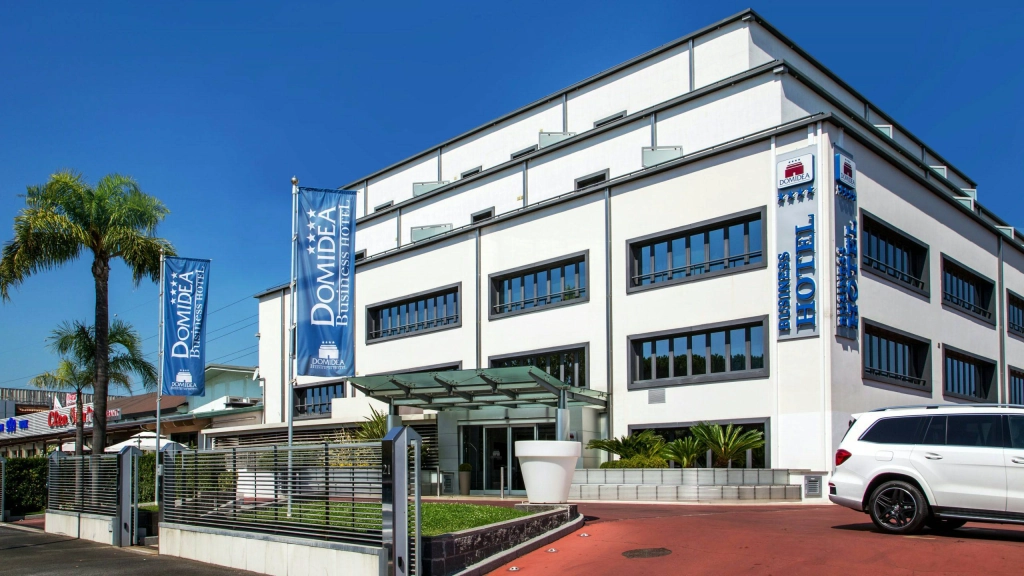
Hotel Domidea is a four-star property in Tor Cervara, near GRA exit 14 and the A24 urban branch, with access towards Tiburtina and eastern business districts. It is not in the historic centre. That position is most useful when the itinerary includes Rome East, the ring road or onward motorway travel.
Officially listed services include:
- 24-hour reception;
- free Wi-Fi;
- international buffet breakfast;
- meeting rooms;
- luggage storage and taxi booking;
- private external unguarded parking subject to availability;
- covered unguarded garage at €5 per car per day, reservable subject to availability;
- Courtesy Bus to/from Repubblica (Metro A) and Rebibbia (Metro B), at set times, on request and subject to availability.
The 42-square-metre Aurea meeting room is described as equipped for audio and video presentations. Capacity, layout, technology and catering must be quoted for the event.
The external parking is not explicitly described as free in the official facilities wording reviewed. Confirm cost, space and vehicle compatibility. The Courtesy Bus should not be treated as an on-demand private transfer.
A productive 36-hour itinerary
Arrival evening
Reach the hotel, confirm the morning route, prepare invoice data and test video-call access. If driving, settle parking before unloading equipment. Eat near the hotel rather than crossing Rome without purpose.
Meeting day
Use the confirmed shuttle/metro for central appointments or leave early by car for outer districts. Group meetings geographically. Place lunch near the afternoon venue and reserve a quiet hour for email follow-up.
Final morning
Hold a short meeting at the hotel or complete one nearby appointment. Check out, use luggage storage if needed and depart towards Tiburtina, Termini, airport or motorway with a realistic margin.
A confirmed agenda deserves a confirmed room—not a last-minute compromise after corporate demand rises. Open Hotel Domidea’s official booking engine, check the current rate and secure your stay now. For company agreements or a tailored proposal, email info@hoteldomidea.com.
Common mistakes
1. Choosing a hotel by distance from the Colosseum rather than the meeting.
2. Comparing room rates without city tax, breakfast, parking and cancellation.
3. Using midnight map times for rush-hour travel.
4. Booking Fiumicino because the flight is cheaper without pricing the transfer.
5. Driving into a ZTL because the navigation app suggests it.
6. Assuming parking is free, guarded and guaranteed.
7. Treating a scheduled hotel shuttle as on demand.
8. Booking AV equipment only after participants arrive.
9. Waiting until checkout to request a complex invoice.
Frequently asked questions
What is the best area to stay in Rome for business?
The area closest in travel time to your most important meeting. Tiburtina/eastern Rome suits A24 and eastern districts; EUR suits southern offices; Fiera/Fiumicino suits exhibitions and airport-led schedules; Prati suits north-western appointments.
How much does a Rome business trip cost per day?
There is no reliable universal total. Add the live hotel rate, tax, breakfast, mobility, meals, parking and time cost for your dates.
Is public transport cheaper than taxis?
Usually per journey, but a taxi may be better value when time, luggage or several passengers matter. Compare door-to-door cost and risk.
Should I stay near Termini or Tiburtina?
Choose Termini for broad metro/rail connectivity and Tiburtina for eastern Rome, some high-speed services and the A24 side.
Is Rome East good for business travellers?
Yes when meetings or onward routes are east, around the GRA, Tiburtina, Collatina or Prenestina. It is less efficient for repeated west-Rome appointments.
Does Hotel Domidea have parking?
Yes, but both external parking and the paid garage are subject to availability. Confirm the appropriate option.
Does Hotel Domidea have meeting space?
Yes. It advertises meeting rooms including the 42 m² Aurea room. Request a proposal for layout, equipment and catering.
Can companies request dedicated rates?
The hotel invites business and company enquiries. Email dates, room volume, recurrence and billing needs for a tailored response.
Is the shuttle always available?
No. It operates at set times, on request and subject to availability.